
Automotive Metal Fabrication Equipment
Automotive and transportation frame rails, cross members, chassis brackets, and body panels all have to come off the floor to spec and on schedule, often in higher-strength steels that fight back every time you try to form them. That’s where we come in. At Wysong, we bring a century of experience to automotive metal fabrication, with equipment that’s built to handle the heavier gauges and tighter tolerances that automotive and commercial vehicle production depend on. Discover what we can do for your shop.
Wysong Products



What the Industry Demands
The math is different when you’re fabricating for the auto industry. Tolerances are unforgiving, volumes climb quickly, and the material is often thicker and stronger than what a general job shop sees day to day. High-strength low-alloy and advanced high-strength steels are standard in modern vehicle structures, and they require greater tonnage and better ram control than mild steel. Our hydraulic press brakes range from 44 to 1,100 tons across the MB through MD series, giving you the headroom to form heavy structural parts without babying the machine.
For the parts suppliers feeding OEM lines, that range matters. Fabrication equipment for automotive parts suppliers has to cover a lot of ground, from small formed brackets to long structural members, and a single shop floor needs both precision and brute force. Sheet metal fabrication equipment for automotive manufacturing also has to hold up under production schedules that don’t let up. Wysong machines are known for durability, which is why units we shipped decades ago are still cutting and forming parts today. When a line goes down, it costs money, so we back every machine with US-based field service and phone support from people who have spent their careers around this equipment.

Equipment for Automotive and Transportation Fabrication
From blanking raw stock to forming finished parts, Wysong has a machine for each step. This is where automotive structural component fabrication equipment has to work as a system rather than a set of standalone machines.
Press Brakes
Most automotive structural parts get their shape on a press brake, and the choice comes down to tonnage and bed length, plus how much high-strength material you run. A CNC press brake for automotive manufacturing needs repeatability you can trust for thousands of cycles, because a bend angle that drifts even slightly shows up fast in downstream assembly. Our hydraulic MB through MD series cover 44 to 1,100 tons, and our electric models handle lighter, higher-speed work from 25 to 220 tons. For the long parts that define commercial vehicle fabrication equipment, our tandem press brakes pair two synchronized machines to form a single workpiece that no standalone brake could handle. That’s how shops bend truck frames, trailer rails, and railcar panels in one pass, instead of sectioning and welding shorter pieces together.
Fiber Lasers
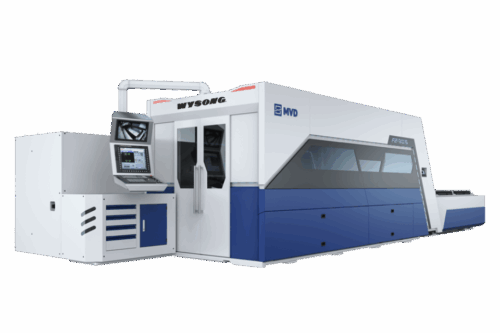
When automotive parts call for intricate profiles or perforated patterns, a fiber laser cutting machine for automotive work earns its place fast. Our A through FM series lasers cut clean edges on the steel and aluminum common in vehicle structures, and the tighter the tolerance, the more that edge quality pays off in fit and weldability. For shops moving toward EV and lightweighting work with aluminum, laser cutting holds profiles precisely without the secondary cleanup a plasma table leaves behind.
Shears
Before a part is formed, it has to be blanked to size, and a square, accurate blank is the foundation for everything downstream. A metal shear for automotive production has to deliver clean, consistent cuts at volume without walking out of tolerance. Wysong hydraulic shears in the MB and MC series bring the power for heavier plates, and our mechanical shears come in heavy-duty and high-speed configurations to match your material and throughput. Getting the blank right the first time saves you from chasing dimensional problems several operations later.
Folders and Finishing
Our lineup doesn’t stop at forming and cutting. Wysong also builds CNC folders for panel and enclosure work, along with finishing equipment that cleans up edges and flattens stock before parts move on to assembly and welding.
Built To Last, and Backed for the Long Haul
Wysong has been a name in metal fabrication for over a century, with more than 40,000 machines shipped and supported across North America. Every machine receives an average of 40 hours of quality assurance before it leaves our 110,000-square-foot facility in Greensboro, North Carolina. For automotive and transportation suppliers who care about domestic sourcing and supply chain stability, that US manufacturing base counts for something. And when you eventually need parts, service, or a control upgrade years down the road, we’re still here to support the machine you bought, along with most other OEM brands already on your floor.
Let's Spec the Right Machine for Your Shop
Tell us about the parts you build and the volumes you run, and our team will help you match the right machines to the work. We’ll help you buy the machine that fits, and we’ll be around to support it long after it hits your floor.
Automotive Metal Fabrication FAQs
High-strength low-alloy (HSLA) and advanced high-strength steels take considerably more tonnage to form than mild steel of the same thickness, sometimes well over twice as much, because their higher yield strength resists bending and springs back harder. The heavier the gauge and the higher the grade, the more tonnage and frame rigidity you need. Wysong hydraulic press brakes go up to 1,100 tons, which covers the vast majority of automotive structural forming. The right number depends on your material grade and the geometry of the part, so it's worthwhile to work through the specifics with an application engineer.
Yes, though the two pull in opposite directions. AHSS demands more tonnage and careful tooling selection to manage springback, while aluminum forms easily but marks and scratches if the tooling and handling aren't dialed in. Vehicle lightweighting means a lot of shops now run both in the same week. Our press brakes and fiber lasers are built for that mix, and our team can help you set up tooling and programs for the grades you're running.
Long structural parts are where tandem press brakes come in. Running two synchronized machines together lets you form a workpiece far longer than a single brake could handle, which is exactly what commercial vehicle and railcar fabrication often demands. Wysong builds tandem systems on its MB, MC, and MD hydraulic platforms for this reason, so you can bend truck frames and trailer rails in one pass instead of sectioning and welding shorter pieces together.
Wysong manufactures and supports equipment from a 110,000 square foot facility in Greensboro, North Carolina, and has for generations. For automotive and transportation suppliers, domestic manufacturing means shorter lead times on parts and service and faster access to a technician when a machine goes down. It also helps suppliers who need to document domestic content for their own customers.