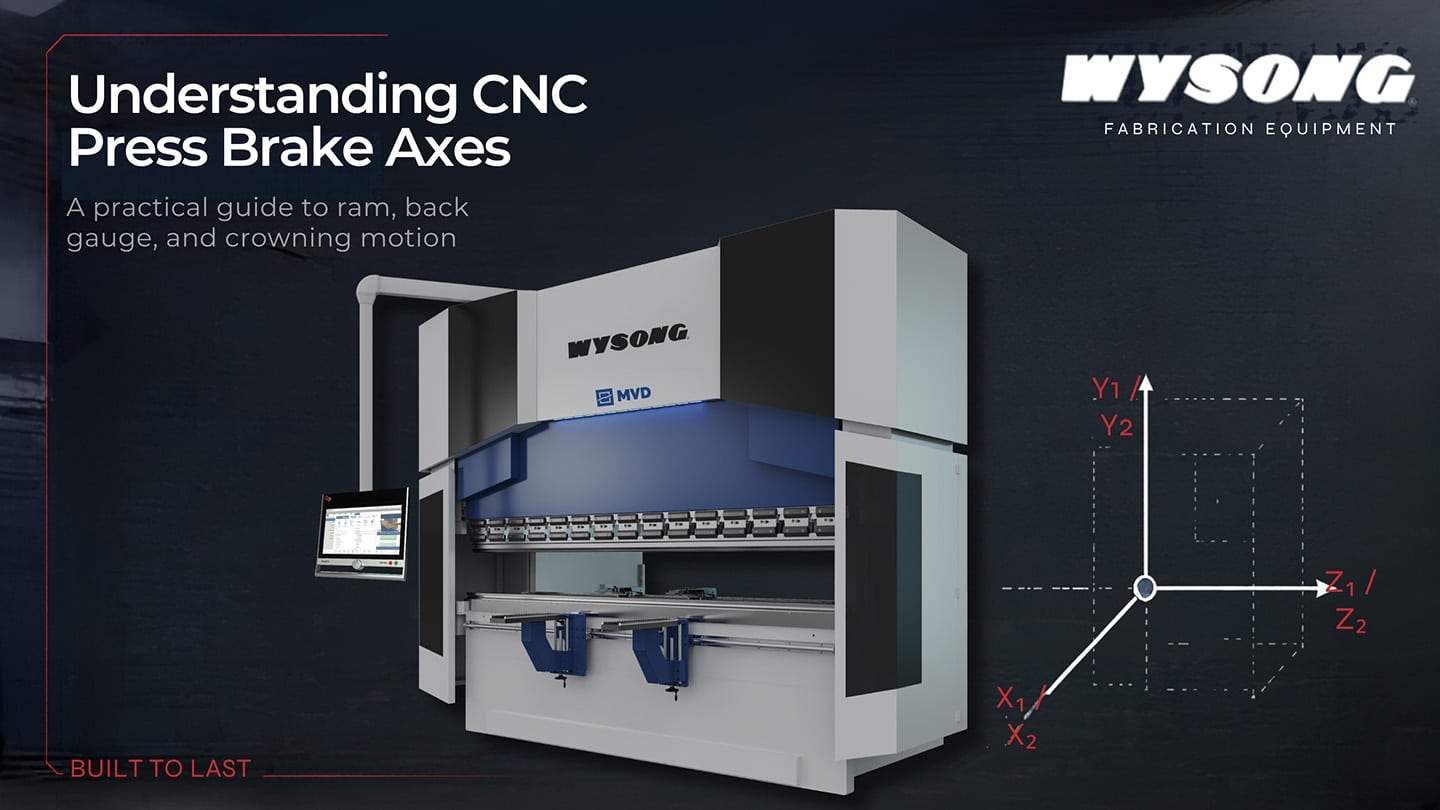
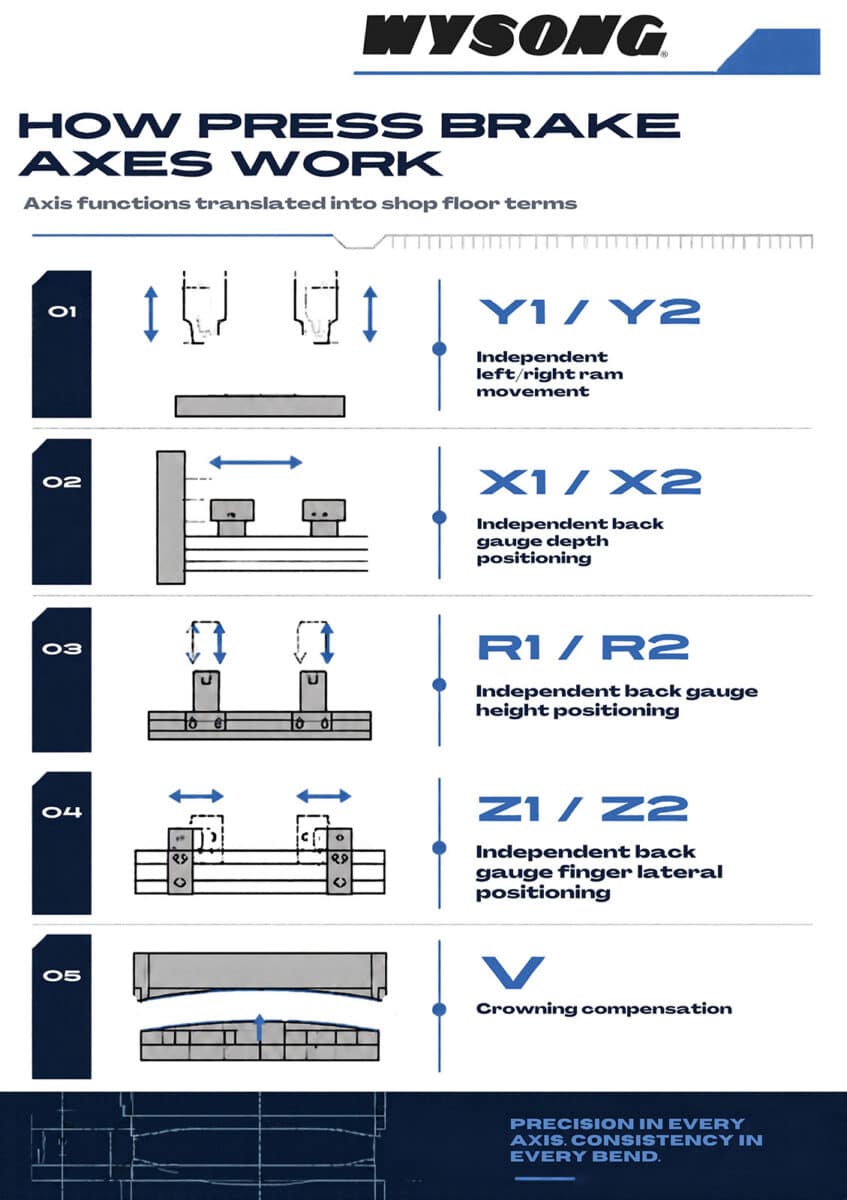
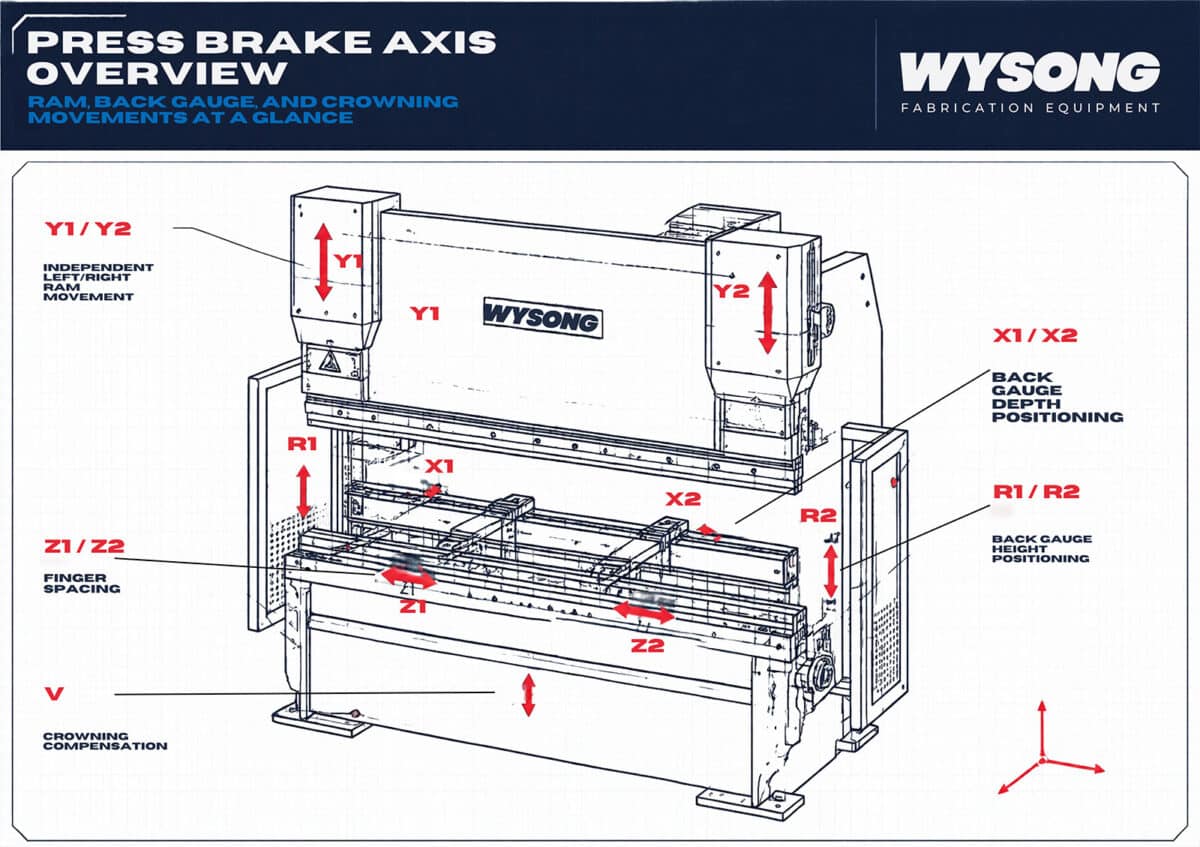
A press brake axis is any motion the CNC control drives on its own. Most CNC press brakes have two axes on the ram (Y1 and Y2), one to six on the back gauge (X, R, and Z), and often a crowning axis (V). The more back gauge axes a machine has, the more part shapes you can set up without moving the stops by hand.
What does each press brake axis do?
| Axis | What moves | What it controls |
|---|---|---|
| Y1 | Left side of the ram | How far the left side of the ram comes down, which sets the bend angle |
| Y2 | Right side of the ram | Same on the right side. Running Y1 and Y2 separately keeps the ram level, or tilts it on purpose for a tapered bend |
| X (X1, X2) | Back gauge fingers, front to back | Flange length. With X1 and X2, each finger moves on its own |
| R (R1, R2) | Back gauge fingers, up and down | Gauging height, so you can switch die heights or gauge off a flange that’s already bent |
| Z1, Z2 | Back gauge fingers, side to side | Where each finger sits along the bed, for narrow parts and offset bends |
| V | Crowning system | Makes up for the bed and ram flexing under load, so the angle stays the same from one end of a long bend to the other |
What are the common back gauge setups?
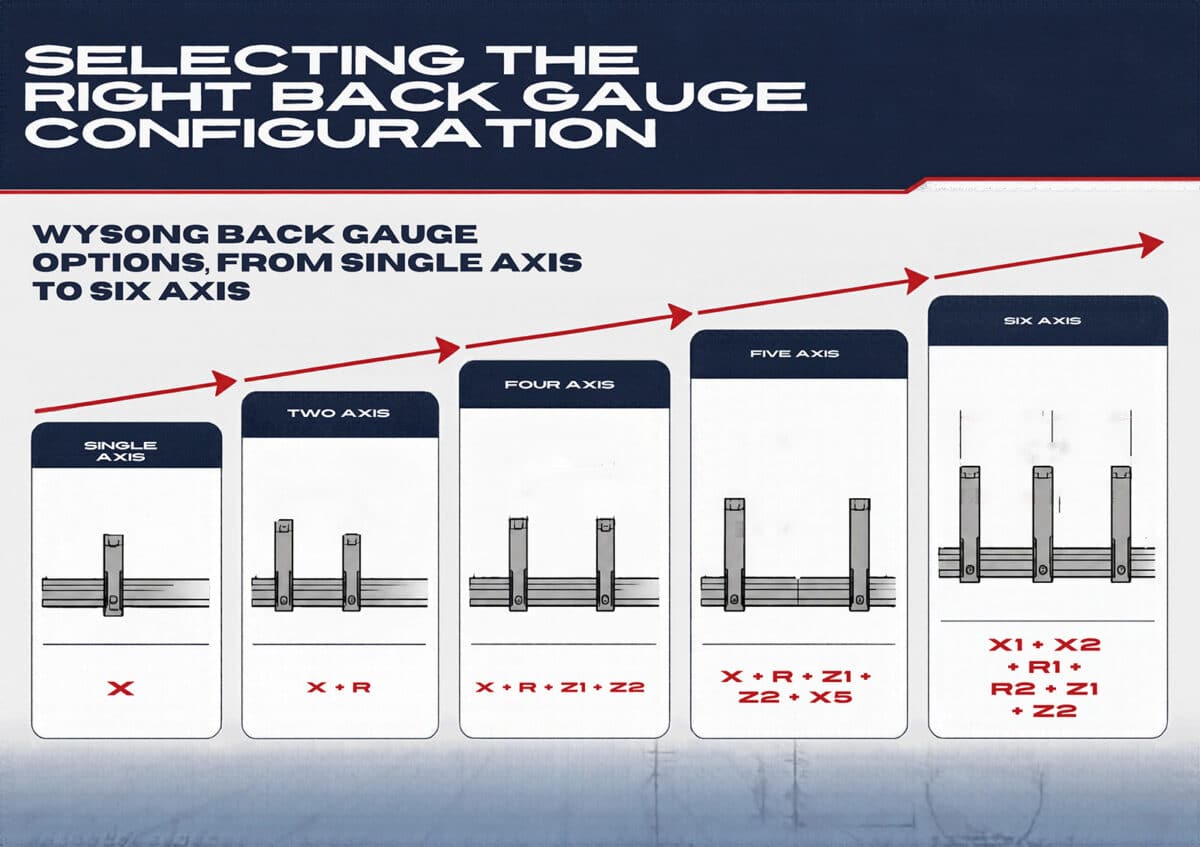
The axis count on a spec sheet usually includes Y1 and Y2. That’s why a machine with only an X back gauge often gets sold as “3-axis.”
| Back gauge axes | Often sold as | Best for |
|---|---|---|
| X | 3-axis | Simple parts with one or two bends, long runs of the same part |
| X, R | 4-axis | Different die heights, flanges already bent, mixed jobs |
| X, R, Z1, Z2 | 6-axis | Short runs, frequent changeovers, narrow parts, offset bends |
| X1, X2, R, Z1, Z2 | 7-axis | Angled or tapered gauging |
| X1, X2, R1, R2, Z1, Z2 | 8-axis | Complex parts where each finger needs full independent movement |
What should you ask about an axis count?
Ask how many axes are on the ram, how many are on the back gauge, and whether crowning is counted. An axis count looks like a spec you can compare side by side, but it isn’t always. Two “6-axis” machines can be built very differently. One might put four axes on the back gauge. Another might count crowning and leave the back gauge with only X and R. Get the breakdown in writing before you compare quotes.
How do you choose the right number of axes?
The right axis count depends on your parts, not the spec sheet. Simple parts in long runs only need X. Mixed jobs with different die heights need X and R. Short runs, narrow parts, and offset bends are where Z1 and Z2 pay for themselves in setup time saved.
- Part complexity: One or two bends on simple parts? X covers it. Parts with several flanges or different heights need R.
- Run length: If you change jobs several times a shift, Z1 and Z2 save setup time on every changeover, because nobody has to slide the fingers by hand.
- Part width: Narrow parts and offset bends need the fingers positioned side to side, which means Z axes.
- Bend length: On long bends, crowning (V) is what keeps the angle consistent from end to end.
- Your operators: More axes mean less manual setup, which helps when you’re training new operators.
What does a multi-axis back gauge look like in action?
Which Wysong press brakes have which axes?
| Series | Ram | Standard back gauge | Options |
|---|---|---|---|
| MB Series (44 to 350 ton) | Y1, Y2 | X | Back gauges up to 6 axes |
| MC Series (110 to 550 ton) | Y1, Y2 | X, R | Back gauges up to 6 axes |
| MD Series (150 to 1,100 ton) | Y1, Y2 | X, R | Back gauges up to 6 axes |
Wysong controls are non-proprietary. They come from Delem, ESA, or Cybelec, so you’re not locked into one supplier for parts and support.
Frequently asked questions
It moves the back gauge fingers toward or away from the tooling. That sets your flange length.
On most machines, a 4-axis back gauge moves front to back (X) and up and down (R). A 6-axis back gauge adds Z1 and Z2, so the fingers also move side to side.
It is if you run short jobs with frequent changeovers, or narrow parts with offset bends. For long runs of simple parts, X and R usually do the job.
V is the crowning axis. It makes up for the bed and ram flexing under load, so the bend angle stays consistent along the full length.
Not sure how many axes your work needs?
Try our tonnage calculator, request information, or call (800) 299-7664. Wysong has been helping shops choose the right machine since 1903, and we’ll walk through your parts with you.