
Agricultural Equipment Fabrication Machinery
Grain bins, hoppers, chassis frames, and trailer bodies all come off the same shop floor, so agricultural equipment fabrication machinery must move between heavy plate and thin panel without slowing the line. Wysong builds the equipment that farm implement and trailer manufacturers rely on to cover both ends of that range, from AR400 wear plate on a tillage tool to a galvanized panel on a grain bin roof.
Wysong Products




Why Agricultural Equipment Manufacturers Choose Wysong
Ag equipment fabrication rarely stays in one lane. A single production run might call for HSLA plate on a frame rail, mild steel on a box blade, and lighter-gauge sheet on a hopper wall, sometimes in the same week.
That’s where metal fabrication equipment for agriculture has to earn its keep, and it’s where Wysong’s range fits: heavy-duty hydraulic shears and press brakes for the thicker materials and full-panel processing that frame and chassis work demands, alongside electric press brakes and CNC folders for the sheet and panel side of the shop.
Farm implement and trailer manufacturers can handle both heavy and light work on the same equipment. They don’t need a separate machine setup for each.

Equipment for Every Stage of Ag Equipment Fabrication
Ag equipment fabrication moves through the same stages, whether the job is heavy plate or light sheet: shearing stock to size, forming it to shape, and finishing the edges before weld-out or assembly. Wysong covers each of those stages with purpose-built equipment.
Press Brakes
A press brake for agricultural equipment manufacturing has to do two different jobs well. Wysong’s hydraulic MB, MC, and MD Series cover 44 to 1,100 tons, with heavy-duty models forming beds up to 30 feet for the frame rails, box blades, and structural brackets that run in thicker plate. On the panel and hood side, electric MS and ME Series brakes (25 to 220 tons) hold the repeatability that high-volume, thinner-gauge runs need without the tonnage overhead of a hydraulic machine.
Fiber Lasers
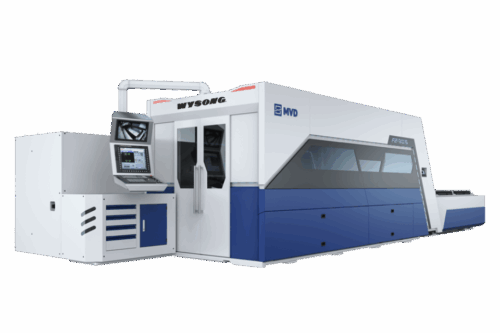
A fiber laser cutting machine for agricultural parts has to hold a clean edge for a wide range of thicknesses, from thin sheet on a shroud or guard to heavier plate on a wear part. Wysong’s A, F, and FM Series fiber lasers cut that full range, giving shops a single cutting platform instead of switching processes as material gauge changes across a job.
Shears
Before anything gets bent, it has to be sheared square. A heavy-duty shear for agricultural equipment blanks plate and sheet stock fast and to dimension, which is essential when a frame weldment and a hopper panel are both waiting on the same cut list. Wysong’s hydraulic MB and MC Series shears, along with mechanical shears in heavy-duty and high-speed configurations, cover that range.
Sheet Metal Folders
A sheet metal folding machine for farm equipment earns its keep on large panels and long flanges, grain bin sections, hopper walls, and cab or hood components, where a press brake would need two operators to keep the material flat and square. Wysong’s Regfold and Apexfold lines handle that work without retooling between gauges.
Finishing Machines
Metal finishing equipment for agricultural fabrication matters more than shops sometimes budget for. Deburring and leveling clean up edges on parts that will be welded, painted, or handled in the field, reducing rework and keeping assembly moving.
Equipment Built to Last in the Field
Wysong has been building metal fabrication equipment for over a century, and the shops we work with in agriculture value what farmers do: machines that keep running through a full season and years beyond. Every unit ships after an average of 40 hours of quality assurance at our 110,000-square-foot facility in Greensboro, North Carolina, backed by US-based field service and phone support.
Let's Spec Your Ag Fabrication Line
Whether you’re adding tonnage for heavier implement work, replacing aging shear or brake capacity, or building out a line that runs both plate and panel, our team will help you match the right machines to what you’re producing. Request information on what you need, and let’s talk it through.
Agricultural Equipment Fabrication Machinery FAQs
Abrasion-resistant plate like AR400 and AR450 work-hardens and resists forming more than mild steel of the same thickness, so it needs a larger bend radius and more tonnage to avoid cracking at the bend line. Heavier tillage and wear-part fabrication often calls for the tonnage range Wysong's hydraulic MD Series and heavy-duty press brakes are built for, up to 1,100 tons, rather than a standard mid-range brake sized for mild steel.
Yes, and most ag equipment manufacturers need to. A frame rail might call for A572 Grade 50 HSLA plate while a hopper wall on the same order calls for lighter HSLA or galvanized sheet. Wysong's press brakes run from 25-ton electric models built for thin-gauge repeatability up to 1,100-ton hydraulic and heavy-duty models for structural plate, covering both without two machine footprints.
A grain hopper panel carries tons of shifting weight and takes constant vibration from PTO-driven equipment, so the weld and bend line have to hold up under repeated load over years in the field. That's a different priority than the tight angular tolerances a precision sheet metal shop chases. Consistent, repeatable bend geometry during a full production run counts for more here than fractional-degree accuracy.
Yes. Our PC800 control retrofit is built to work with most other manufacturers' press brakes and shears, not just Wysong equipment. For an older machine that's still mechanically sound, a control upgrade is often a fraction of the cost of replacement and adds CNC repeatability to a production line without a full capital swap.