
Sheet Metal Fabrication Equipment
A production line rarely stalls because a machine can’t make the part. It stalls because the machine makes the part a few seconds slower than the line requires, or because a setup that should take two minutes takes fifteen on second shift. In a high-volume plant, sheet metal fabrication equipment is judged on performance over thousands of cycles. Wysong builds the shears, press brakes, and fiber lasers that industrial manufacturers run at that pace, with the frame rigidity and control repeatability that keep parts in spec from the first piece of a run through the last.
Wysong Products




What High-Volume Production Needs From a Machine
Buying sheet metal fabrication tools and equipment for a factory is different than buying for a shop that handles all kinds of one-off jobs. A job shop needs flexibility because they never know what’s coming next. A plant that makes the same parts week after week needs something else: speed, quick changeovers, and a machine that doesn’t break down.
That changes what to look for. You want a machine built solid enough to hold its accuracy even after running non-stop. You want the backgauge (the part that positions your material) accurate enough that you don’t have to stop and test-bend every time you switch jobs. And you want controls simple enough that any operator can learn them in one shift.
Downtime is where you really lose money. If your bottleneck machine goes down for an hour, you’re not just losing an hour of that machine’s work — you’re losing an hour from your entire line. That’s why, when you’re comparing machines, you shouldn’t just look at tonnage and bed length. You also need to ask: How easy is it to get parts? How fast can they send someone to fix it? And how long will they keep supporting this machine down the road?
Equipment for Every Step of the Process
No matter what part you’re making, it goes through the same basic steps: cut the material to size, cut out the shape, bend it into form, then smooth the edges before welding or assembly. Wysong makes sheet metal fabrication machinery for every one of those steps. That means a plant can stick with one brand and one service contact instead of juggling four different suppliers.
Shears
Blanking (the first cut) sets the ceiling for how accurate everything else can be. If your blank isn’t square, nothing you do later will fix that (the press brake certainly won’t).
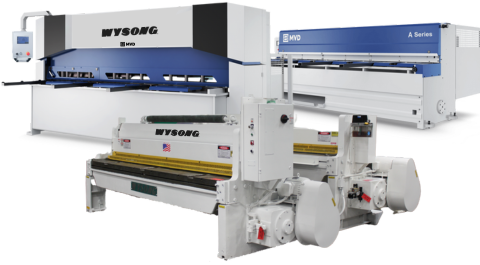
For fast, straight cuts on high volumes, mechanical shears beat hydraulic ones. They use a flywheel and clutch to run faster cycles. Wysong’s high-speed models can hit 300 strokes per minute on lighter material. They’re also simpler machines, which means less maintenance over the years.
Thick plates and tougher metals are a different challenge. Our MB Series hydraulic shears have adjustable blade clearance and a servo-driven backgauge, built for heavy-duty work on thick material. The MC Series goes a step further with variable rake. It automatically adjusts the blade angle as it cuts, based on the material and thickness. That means cleaner cuts and less burr, whether you’re cutting stainless, aluminum, or mild steel.
Pro Tip: If your plant runs both light sheet and heavy plate, you’re usually better off with one of each machine rather than trying to make one do both jobs.
Press Brakes
Bend accuracy is where most sheet metal parts pass or fail quality checks. In high-volume production, the real enemy is drift (small errors that creep in over time). A bend angle that’s off by half a degree won’t show up on the machine, but it’ll show up loud and clear when the part hits assembly.
Electric press brakes solve part of this problem by removing hydraulics altogether. No hydraulic fluid, no constant pump noise, and up to 50% lower energy costs, because the motors only draw power when bending, instead of running a pump the whole time.
Our MS Series covers 25 to 110 tons on beds from 3 to 10 feet. The ME Series steps up to 110-220 tons on 10-13 foot beds, using belt-driven servo motors for smooth, fast ram movement.
For heavier structural work, our hydraulic press brakes go from 44 tons all the way to 1,100 tons:
- MB Series: 44-350 tons
- MC Series: 110-550 tons
- MD Series: 150-1,100 tons
All of them can handle bed lengths up to 30 feet. For parts longer than any single brake can handle, we offer tandem setups: two machines synced together to bend one long workpiece as a single unit.
Fiber Lasers
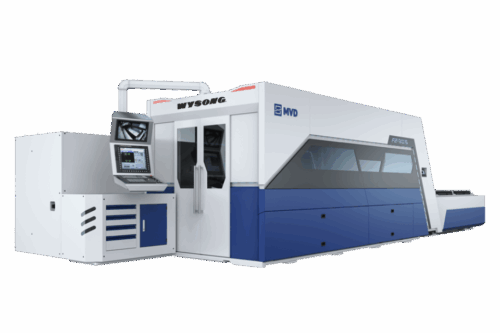
Wysong’s fiber lasers range from 2 kW to 30 kW in our A and F Series. Both come with automatic shuttle tables, so an operator can load one pallet while the machine keeps cutting on the other: no waiting around.
For plants tight on space, the FM Series offers 2 kW to 6 kW in a compact, fully enclosed cabinet with built-in fume extraction.
All three series cut mild steel, stainless, aluminum, copper, and brass, which matters if your shop switches between different materials depending on the job.
Folders and Finishing
For large panels and long flanges, a folder is faster than a press brake, and you don’t need a second person standing there holding the material flat. The Regfold Series handles mild steel up to 14 gauge. The Apexfold Series goes up to 6 gauge, with strong clamping and folding beams built for heavier enclosures and architectural work.
Parts plants tend to underestimate the value of finishing equipment, because cleaning up rough edges is work that never shows up on a job sheet; it just eats time. That’s where the Surfacer Series comes in: it removes burrs using abrasive belts, brushes, or a combination of both. The Surfacer Lite handles smaller parts and lower-volume jobs that don’t need CNC.
Level Tech is worth adding right after your laser. Laser cutting and stamping leave internal stress in the metal, and Level Tech’s servo-controlled rollers relieve that stress so the part lies flat, instead of fighting your backgauge later on.
The Bevel Wizard handles weld prep on both straight edges and curved shapes.
Built to Last
Wysong has been building metal forming equipment for over 100 years, and machines we shipped decades ago are still cutting and forming parts today. Every machine goes through an average of 40 hours of quality testing at our 110,000-square-foot facility in Greensboro, North Carolina, backed by US-based service and phone support. If your customers require you to document domestic sourcing, that’s one less thing to worry about.
Our support doesn’t end once we build the machine. Wysong rebuilds equipment, either in our factory or on-site, and our universal shear and press brake controls can be retrofitted onto most other manufacturers’ machines. So if you’re running a mix of brands, you can bring everything onto one control system without replacing your whole fleet at once.
Let's Find the Right Equipment for Your Numbers
Tell us what you make: material, part sizes, cycle times, and target volumes. We’ll help you figure out where your line is getting stuck and which sheet metal manufacturing equipment will fix it; whether that means more tonnage, new blanking capacity, or updated controls on your current fleet.
Manufacturing and Industrial Fabrication FAQs
Tonnage depends on more than material thickness. It's also about tensile strength, bend length, and how wide your V-die opening is. A good starting point is a V-die opening about eight times the material thickness; the narrower the opening, the more tonnage you need. Two things trip people up: 304 stainless needs about 1.5 times the tonnage of mild steel at the same thickness, while 5052 aluminum needs about half. Always size your machine for your heaviest part, with some room to spare. Running a brake at its max limit every cycle is how frames start to bend and angles start to drift.
Here's the surprising part: extra power helps most on thin material, not thick. Going from 6 kW to 12 kW roughly doubles your cutting speed on sheet under about a quarter-inch thick, which is where most production work happens. On thick plate, the gains are smaller because heat becomes the limiting factor, not power. Higher wattage also burns through nitrogen faster, so it only pays off if you're running the machine hard. Two shifts of thin-gauge cutting? Higher wattage pays for itself fast. Running it occasionally? Probably not worth it.
Steel is sold with a minimum tensile strength, not an exact one. So two coils that both meet spec can still behave differently enough to change the springback by a degree or more. High-volume shops handle this by using angle measurement and adaptive bending built into the control, instead of reprogramming every batch, and by doing first-piece checks whenever the material lot changes.
Depends on what's worn out. On a well-built machine, the frame and ram usually outlast the controls and hydraulics by a long shot. So if the machine is mechanically solid but running an outdated control, it's often a great candidate for a rebuild at a fraction of what a new machine costs. But if the frame is cracked, the ways are worn, or the geometry's shot, rebuilding isn't worth it. Wysong rebuilds machines either at our Greensboro facility or on-site at yours, and checking the frame first is usually what tells you which way to go.
Yes, and if you're running mixed equipment, it's usually the easiest way to boost throughput without buying new machines. Wysong's universal shear and press brake controls are built to retrofit onto most other manufacturers' equipment. Standardizing controls across your floor cuts down training time, lets you move programs between machines, and means you're not stuck depending on the one person who still remembers how to run the old control.